Policy-governed decision workspace
Case Resolution Copilot
A policy-governed AI case-resolution system that converts fragmented evidence and versioned policies into review-ready Decision Briefs, with deterministic risk controls and human approval for consequential actions.
Controlled-pilot readiness gate passed
The bounded Gmail draft journey, PostgreSQL persistence, recovery paths, and authenticated readiness checks passed the recorded gate.
- 83.7%
- Lower raw median case-resolution workflow time (582s to 95s)
- 3/3
- Complete safe workflows, versus 0/3 through the manual path
- 20/20
- Synthetic regression observations passed
System flow
From intake to a governed outcome.
- 01Case intake
- 02Evidence investigation
- 03Versioned policy retrieval
- 04Bounded Decision Brief
- 05Human review
- 06Controlled action
- 07Receipt and reconciliation
The problem
Complex support escalations are rarely blocked by a lack of prose. They are blocked by fragmented facts, unclear policy authority, risky side effects, and uncertain outcomes after an external system times out.
This product is therefore not a general chatbot. It is a governed decision workspace for cases that need investigation, policy evidence, human authority, and a recoverable action trail.
What I built
Built a policy-governed AI case-resolution system that converts fragmented evidence and versioned policies into review-ready Decision Briefs, with deterministic risk controls and human approval for consequential actions.
The role-aware workspace supports Specialists, Supervisors, Administrators, and Auditors across case queues, review workspaces, controlled actions, policies, quality reporting, connections, and team administration.
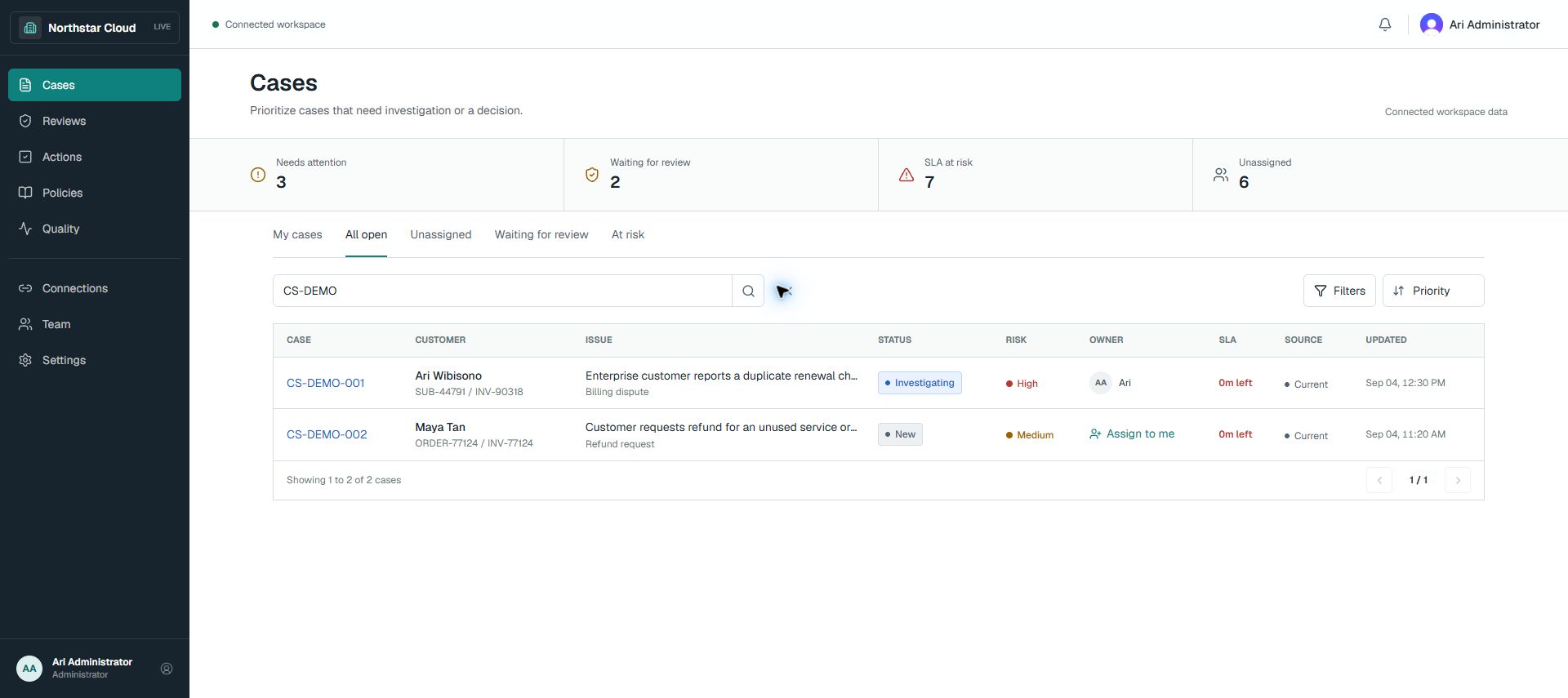
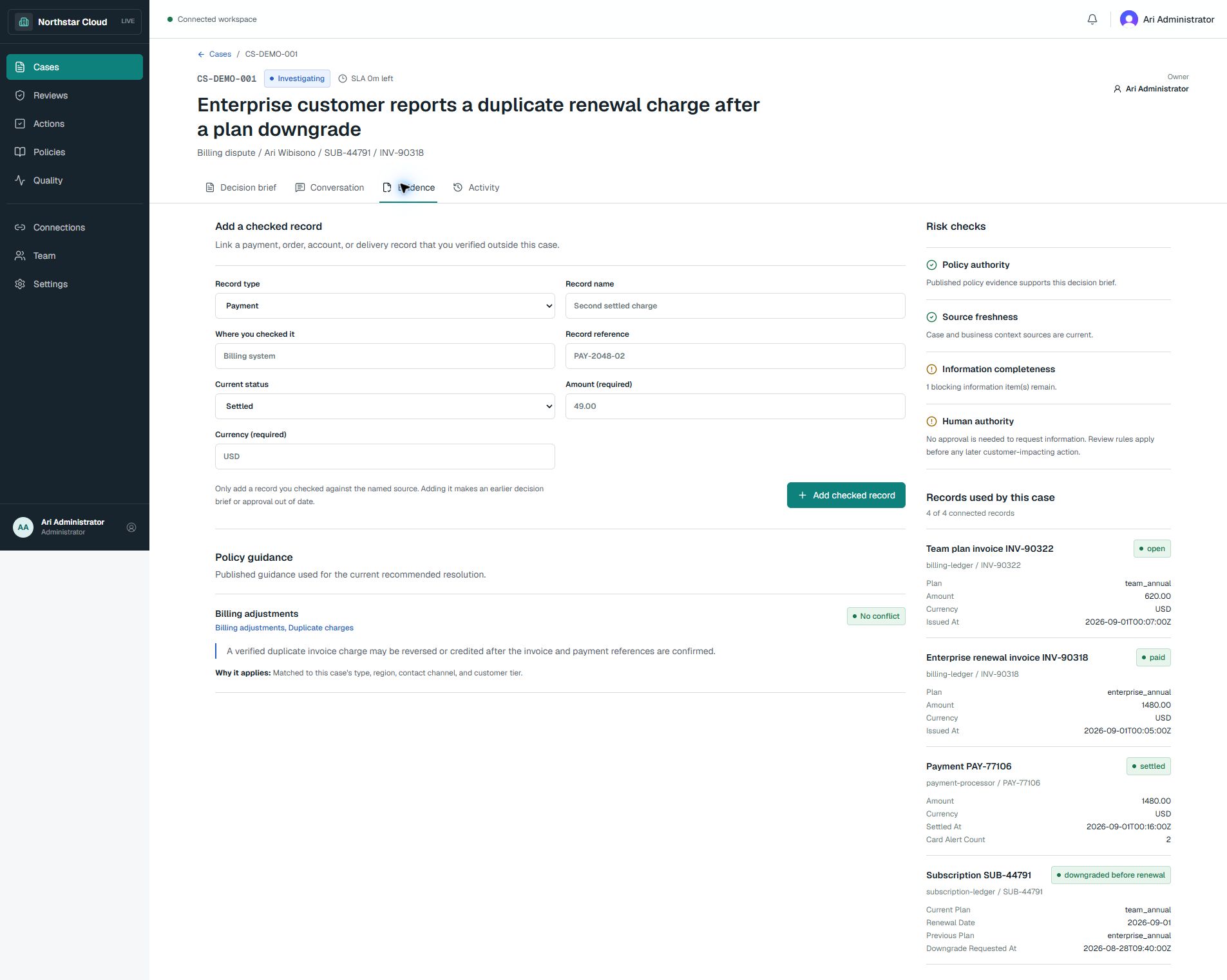
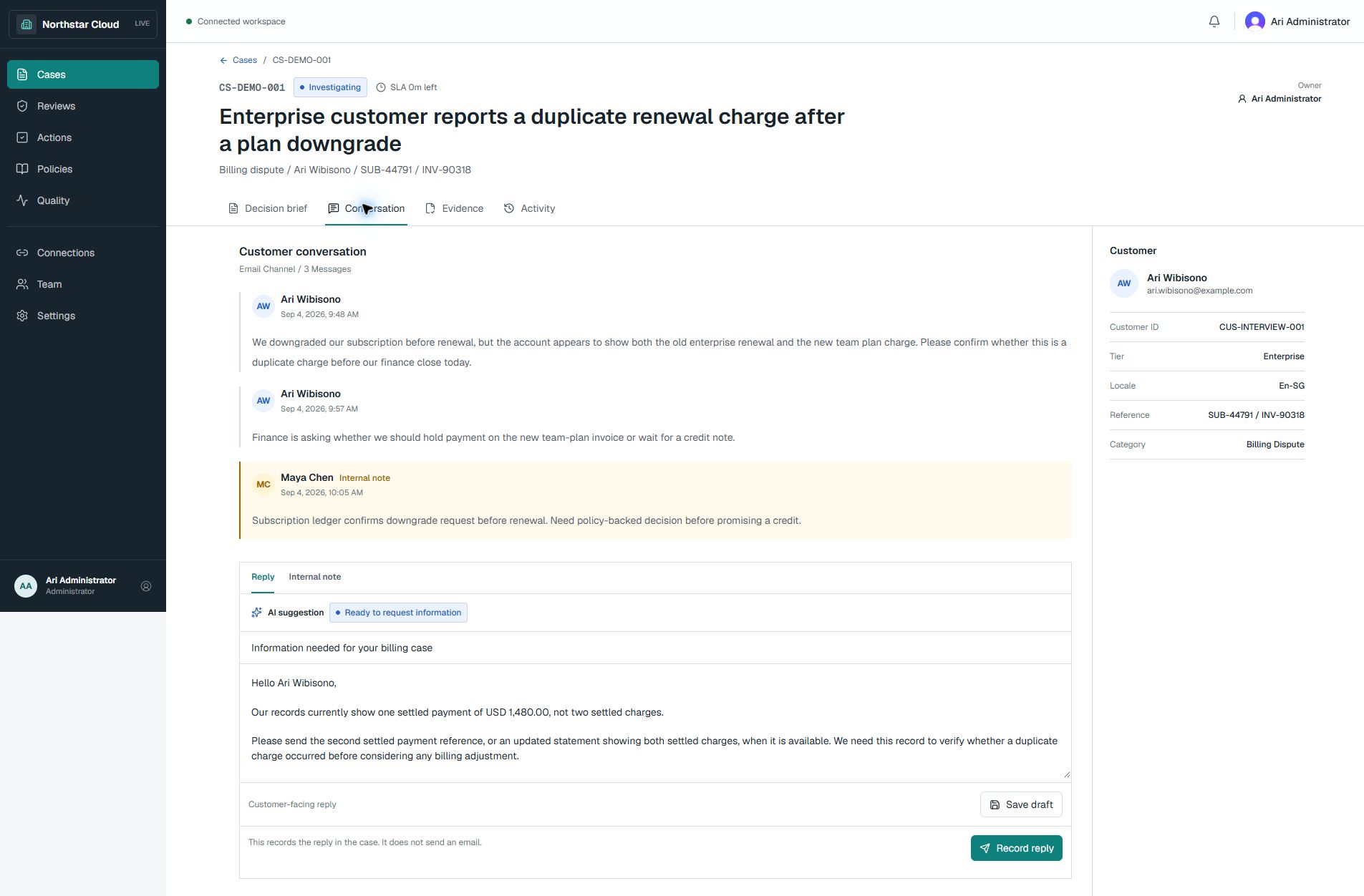
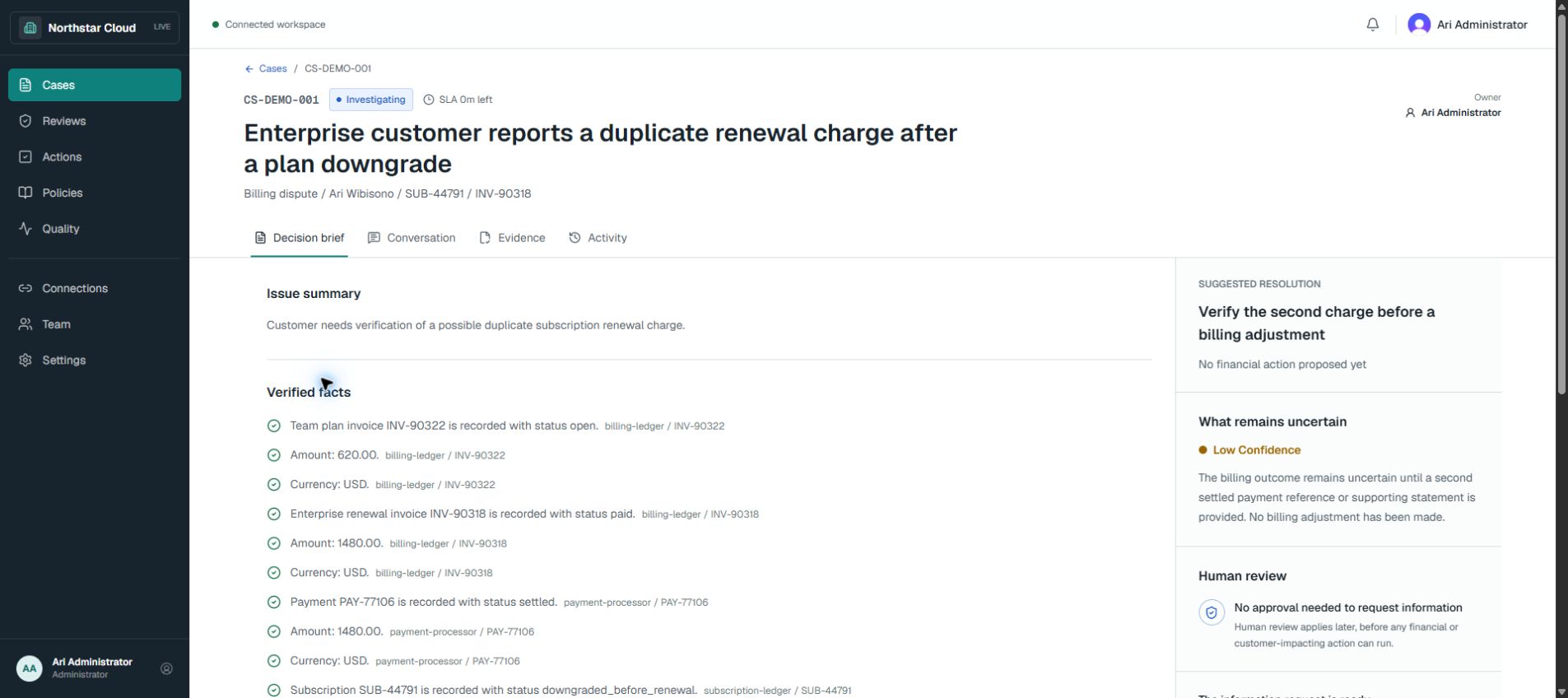
The gallery shows a read-only capture from the invite-only hosted demo on
October 12, 2026. It follows synthetic case CS-DEMO-001 through the queue,
Decision Brief, evidence, and conversation. No case edit, approval, external
action, or outgoing message was performed for those screenshots.
The core journey is:
- Ingest or open a case and gather the relevant business evidence.
- Retrieve only policy versions that are applicable and currently valid.
- Build a Decision Brief that separates verified facts, missing information, risk, uncertainty, and the proposed response.
- Bind human review to an immutable snapshot of the exact evidence, policy, and recommendation that was reviewed.
- Register a controlled action with idempotency and receipt tracking.
- Reconcile an unknown outcome before another side effect is allowed.
The frontend and FastAPI backend are organized as a modular monolith. Domain services, PostgreSQL persistence, and role-aware UI commands stay separated by business boundary without introducing a distributed runtime the product does not need.
Architecture and authority
The implementation uses Next.js, React, TypeScript, Clerk, FastAPI, PostgreSQL/pgvector on Neon, LangGraph, OpenAI, and Vercel. PostgreSQL, rather than the model or graph runtime, is the durable source of truth for business state.
The production workflow runs on LangGraph. LangChain Core supports bounded prompt and schema formatting, while CrewAI and AutoGen remain isolated comparison prototypes validated on one synthetic case; they are not runtime dependencies of the application.
OpenAI is deliberately bounded to narrative work. It may improve the rationale, uncertainty explanation, response subject, and response body derived from a deterministic control record. It cannot change verified facts, risks, actions, financial impact, tenant scope, permissions, or the approval requirement.
The backend owns role checks, organization scope, policy lifecycle, stale-review detection, idempotency, redaction, audit events, and recovery. If case evidence or policy changes after submission, the review becomes stale instead of silently retaining old authority.
Verified outcomes
Reduced raw median workflow time by 83.7% (582s to 95s) in a developer-operated benchmark across three matched synthetic cases; validated critical behavior through 20/20 regression observations, a 3/3 OpenAI canary, and 4/4 PostgreSQL workflow scenarios.
The workflow benchmark completed the full safe workflow in 3/3 Copilot cases, compared with 0/3 through the manual path.
The developer-operated benchmark used three matched synthetic cases. Because the manual runs did not complete the same full safe-workflow boundary, the raw timing difference is descriptive and is not presented as a correctness-controlled speedup.
Evaluation V1 covered 10 synthetic cases with two regression repeats. The OpenAI canary covered three cases with two provider calls, including a correct provider skip when policy was missing. Four persisted PostgreSQL scenarios validated conflict blocking, immutable approval snapshots, exactly-once controlled execution, and unknown-outcome reconciliation.
Public evaluation keeps 86 CFPB, Financial Ombudsman Service, and UCI records separate from three synthetic production-engine controls. These records test the evaluation pipeline; they are not presented as complete customer cases or one aggregate product-accuracy score.
Production and engineering evidence
Engineered the platform with FastAPI, PostgreSQL/pgvector, LangGraph, Celery, and Next.js; strengthened workflow reliability through idempotent actions, audit trails, and worker recovery. Live-validated a reproducible AWS deployment with CloudWatch monitoring across ECS/Fargate, RDS, SQS, S3, Lambda, CloudFront, IAM, and Secrets Manager.
My end-to-end ownership covered architecture, implementation, evaluation, deployment validation, and recovery. Celery and SQS support asynchronous processing, while LangGraph coordinates LLM API integration and inference orchestration within application-enforced controls.
The controlled-pilot readiness gate covered a real, bounded Gmail journey that created an approved persisted draft without automatically sending it, plus PostgreSQL 18.6 and pgvector persistence on a disposable Neon database.
Supporting checks included 73 backend unit and contract checks, 3 PostgreSQL integration checks, 4 provider-fault scenarios, and 35 frontend recovery checks. Warm authenticated primary content was ready in 375 ms against a 2,500 ms gate. That browser timing is a readiness measurement, not an exact Core Web Vitals LCP measurement.
I also validated a temporary AWS deployment of the API and background worker. The connected run covered ECS/Fargate service health, a successful database migration to RDS PostgreSQL with pgvector, S3-to-Lambda-to-SQS-to-Celery processing, worker replacement after interruption, and verified resource teardown. This was a bounded infrastructure test; the always-on demo remains on Vercel and Neon.
How this was verified
- October 12 live product tour
- Case Resolution Evaluation V1
- Developer workflow benchmark
- Earlier hosted controlled-action acceptance
- Operational readiness evidence
- Orchestrator framework validation
- AWS live validation
Failure handling
Consequential actions are registered before execution and protected by idempotency. A successful provider response produces a receipt that can be traced back to the reviewed snapshot.
If a timeout means the side effect may have occurred, the system records an unknown outcome and blocks blind retry. Recovery uses a read-only status check or a human-confirmed resolution before the workflow can continue. This prevents “retry” from becoming a duplicate refund, credit, or account change.
Current boundary
The October 12 product tour shows the hosted interface at source revision
80408ed; it is visual evidence, not an end-to-end acceptance test or proof of
all later revisions. The earlier hosted acceptance separately records
Specialist submission, Supervisor approval, controlled execution, duplicate
blocking, and Auditor inspection on the predecessor deployment.
The evidence covers synthetic cases, one developer operator, a disposable Neon database, and one bounded hosted Gmail draft journey. It supports a controlled-pilot readiness claim, not production-user adoption, customer impact, automatic email sending, production accuracy, or general enterprise readiness.
Product views
The interface around the decision.